Solar panels for schools across Lincolnshire
We survey school and college roofs throughout Lincolnshire, model what each one carries against the school's own consumption, and arrange the design, the grid application and the installation through an MCS-certified partner.
- Schools and colleges
- 359
- 106,234 pupils, DfE Get Information About Schools
- Modelled yield
- 891 kWh/kWp/yr
- Mean across Lincolnshire towns, EU PVGIS v5.2
- School solar on record
- 0 schemes
- Renewable Energy Planning Database Q1 2026, in 0 of the towns we cover
- Network operator
- National Grid Electricity Distribution
- G99 applications and export limits
- Towns covered
- 8
- Surveys arranged county wide
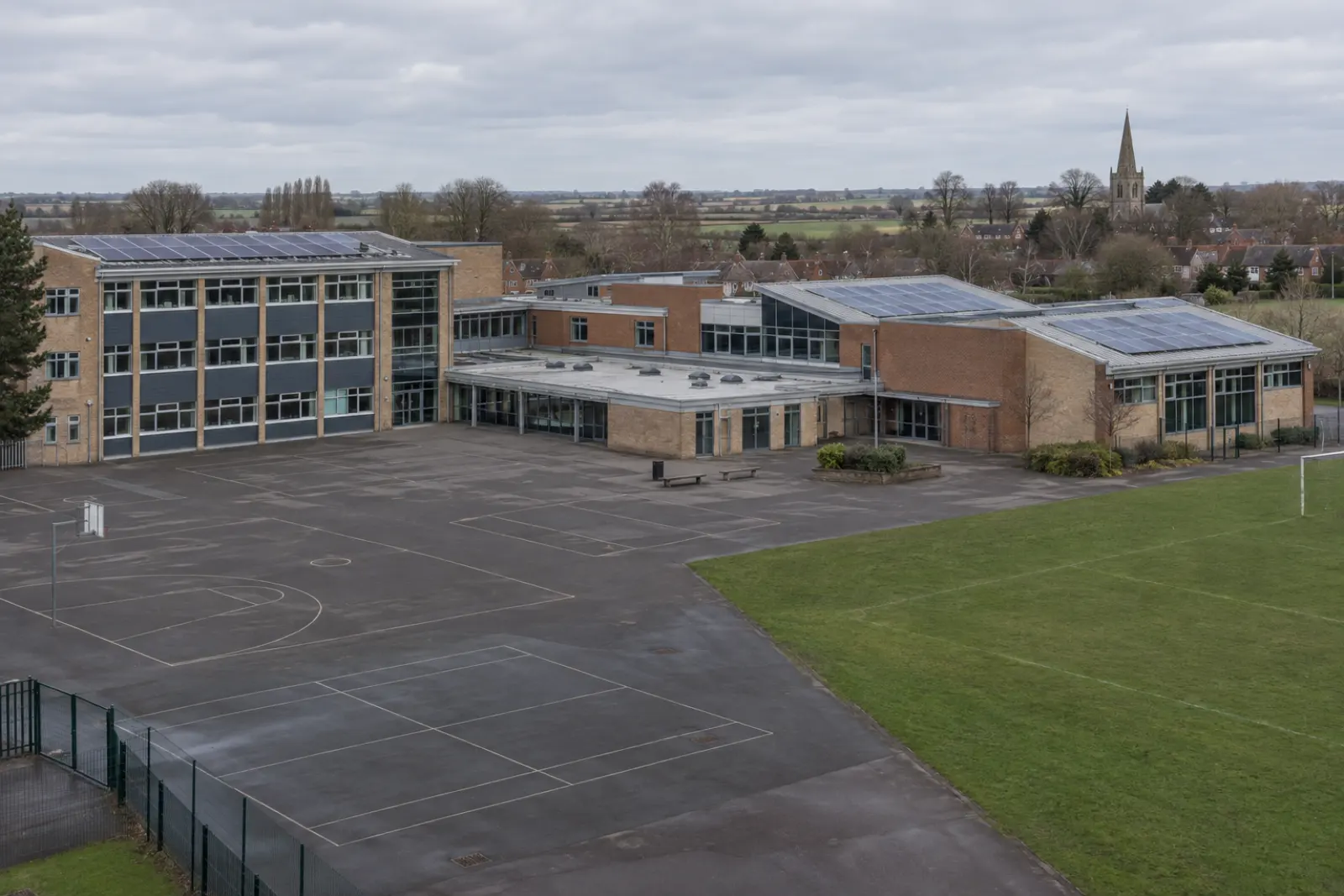
The school estate in Lincolnshire
Lincolnshire has 359 open state-funded schools and colleges teaching 106,234 pupils, spread across 7 local authorities. Source: DfE Get Information About Schools.
Of those, 284 primary, 54 secondary, 17 special and 4 further education. The phase mix is what sets the usable roof area across a county: secondary sites and colleges carry the sports halls, dining blocks and flat roofs, while primaries offer a hall and a teaching block each and suit arrays sized to the base load.
Solar for education buildings and what a Lincolnshire roof models
Modelled yield is not flat across Lincolnshire. Boston comes out at 906 kWh per kWp a year against 861 at Gainsborough, a spread of 45 kWh per kWp. On a 280 kWp school array that difference is about 12,600 kWh a year, which is worth checking before anyone accepts a county-wide saving figure. Source: EU PVGIS v5.2.
Every town page below carries the same arithmetic for that town, including the share of the year that lands in July and August, which is the number a governing body should see before a saving figure.
Solar PV for academy trusts on the Lincolnshire planning record
No school or college solar scheme appears for the Lincolnshire towns we cover in the Renewable Energy Planning Database. That reflects the reporting threshold rather than an empty county: the database captures generating stations from one megawatt upward reliably, and a school array is a fraction of that. Source: Renewable Energy Planning Database, Q1 2026.
Connections across the county run through National Grid Electricity Distribution. Anything above 3.68 kW per phase needs a G99 application, and on a school site the incoming supply and the size of the existing main switchboard are often the real constraint rather than the roof.
- Lincoln 882 kWh/kWp
- Boston 906 kWh/kWp
- Grantham 886 kWh/kWp
- Spalding 902 kWh/kWp
- Gainsborough 861 kWh/kWp
- Stamford 896 kWh/kWp
- Skegness 894 kWh/kWp
- Sleaford 898 kWh/kWp
Book a roof survey at a Lincolnshire school
Send the school postcode and the rough roof area, with half hourly meter data if the trust holds it. We come back with what the roofs carry, what they generate against the timetable rather than against an annual average, and how schools pay for it.
Lenzie Consulting Ltd arranges the survey and introduces an MCS-certified installation partner. We do not install, and nothing on this page is a guarantee of a saving.