Solar panels for schools grants: what is a grant and what is not
Almost everything sold to schools under the heading of solar panels for schools grants is one of four different things, and only one of them is a grant. The others are a loan, a lease dressed as free panels, and capital the school already holds. This page separates them, says which schemes are open and which have closed, and answers the question most schools arrive with: can a school get free solar panels. Every scheme carries its gov.uk or Salix Finance source and the date we checked it.
Contents
Are there grants for solar panels on schools in England?
A grant is money or an asset given to a school with no repayment and no obligation to buy anything afterwards, and as at September 2026 there is no open grant scheme in England that a school can apply to for solar panels.
That is the honest headline, and it is worth more to a business manager than a list of schemes that are not open. Government funding for solar on schools does exist and is real, but it works by selection rather than application: the Department for Education chooses schools and colleges for the Great British Energy Solar Partnership and contacts them. The grant schemes a school could once apply to, run by Salix Finance for the public sector, have closed, and one of them has closed with no successor committed.
What is left is better than it sounds. A school holds capital of its own every year, it can hold it for three financial years, and it decides what to spend it on. Several schools in a trust can pool theirs. That is the route most school arrays in England will actually be funded through, and we set it out in full on our school capital funding page.
Below is every route a school is likely to be offered, what each one really is, and where it currently stands. Read the fourth column first, because the nine rows divide evenly. Three are grants a school can benefit from without ever making an application, three are grants that are closed or do not cover solar, and three are not grants at all. It is also worth being clear that solar is the only renewable energy technology realistically in play on a school site: wind needs a resource and a planning case a school roof cannot offer, which is why solar for schools is where every one of these routes ends up.
Every route a school gets offered, and what it actually is
| Route | What it is | Who it is open to | Is it a grant | Where it stands | Source |
|---|---|---|---|---|---|
| Great British Energy Solar Partnership | Government funded solar panels installed on selected schools and colleges, owned by the school | Schools and colleges chosen by the Department for Education. There is no application route | Yes, a genuine grant in kind | 245 installed, 100 more announced on 16 July 2026 backed by up to £40 million | gov.uk, government solar drive news release, 16 July 2026 |
| Power purchase agreement pilot | A private provider finances, installs, owns and maintains the panels, and the school buys the electricity | Up to 150 schools and colleges in Yorkshire and Humber, the East Midlands and the South East | No. It is a long term supply contract | Selection concluded at the end of summer 2026, procurement from autumn 2026 | gov.uk, funding for installing solar photovoltaic panels on schools and colleges |
| Devolved formula capital | Capital the school already holds and decides how to spend, usable across three financial years | Every eligible school and institution in England | It is a grant, but you already have it | Allocated annually, paid as a single payment in June | DfE, Condition funding methodology and spend guidance 2026 to 2027 |
| Public Sector Decarbonisation Scheme | Salix Finance grant for low carbon heating, with efficiency measures in the same building | Public sector bodies in England including schools and academies | Yes, but never for solar alone | Phase 4 closed 25 November 2024. No further investment committed beyond awarded projects | Salix Finance, Phase 4 project criteria; DfE, CIF 2026 to 2027 information for applicants |
| Low Carbon Skills Fund | Salix Finance grant towards the specialist advice behind a heat decarbonisation plan | Public sector organisations | Yes, but it never bought equipment | Phase 5 closed. No funding in financial year 2025 to 2026 | Salix Finance, Public Sector Low Carbon Skills Fund |
| Condition Improvement Fund | Competitive bidding for named condition projects, scored against published priorities | Single and small academy trusts, CIF eligible VA bodies and sixth form colleges | Yes, but solar is not a priority in any band | 2026 to 2027 round closed 16 December 2025. No 2027 to 2028 round announced | DfE, Condition Improvement Fund 2026 to 2027 information for applicants |
| Renewal and Retrofit Programme | Condition and decarbonisation works, with solar photovoltaic panels named in the phase one scope | Schools and colleges selected by the Department for Education on condition need. Not open to bids | Yes, where sites are suitable | £710 million to 2029 to 2030. Phase one 2026 to 2027 in Yorkshire and the Humber, the East Midlands and the South East | gov.uk, Renewal and Retrofit Programme, published 15 June 2026 |
| Community energy share offer | A community benefit society raises share capital locally, installs on the school roof and sells it the power | Any school whose roof and lease position suit it, subject to the society's own criteria | No. It is a lease plus a supply contract | Run locally by individual societies, not centrally administered | The society's own share offer document |
| Green business lending | Borrowing repayable with interest, sometimes described as a green loan or a sustainability loan | Trusts with borrowing powers, subject to the Academy Trust Handbook rules on borrowing | No. It is debt | Commercially available and unregulated business lending | DfE, Academy Trust Handbook |
All checked 22 September 2026. Schemes, windows and terms change. Verify against the source before you rely on any of it, and take your own legal and financial advice on any agreement.
Can schools get free solar panels, and what is the catch?
Free solar panels for schools describes two entirely different arrangements, one where the government pays and the school owns the system, and one where a private company pays and keeps the system while the school buys back the electricity it generates.
The first is real and narrow. Under the Great British Energy Solar Partnership the Department for Education has funded panels on selected schools and colleges and the school owns them. There is nothing to repay and nothing to buy. As at the 16 July 2026 announcement, 245 schools and colleges already had government funded solar panels and 100 more were announced, backed by up to £40 million. Schools do not apply. The department selects and contacts them.
The second is a power purchase agreement, and it is where nearly every commercial offer using the word free ends up. The department's own description of the model is precise: a private sector provider finances, installs and maintains solar panels at no upfront cost to the school or college, and the school, college or responsible body agrees to purchase the electricity generated by those panels at a pre-agreed rate, usually lower than standard grid tariffs. Nothing in that sentence is a grant. The provider recovers its capital and its margin through the price of the energy, over a term measured in years rather than months.
We are not against the model. For a school with no capital and a good roof it can be a sensible way to cut a bill that is otherwise fixed, and the government is now piloting it deliberately. We are against the word. A school governing body that has been told the panels are free will not have priced the term, the lease over the roof, or the difference between the contracted rate and what the school would have paid for units from an array it owned outright. Those three things are the whole cost of the arrangement.
The four things the word grant gets used for
Before any figure is worth reading, work out which of four things is being described. The test below is not legal advice and it is not subtle, but applied to a proposal in front of a finance and resources committee it separates them in about a minute.
- The money or the asset is given to the school and the school owns what it buys, with no repayment and no obligation to purchase anything afterwards
- The conditions attached are about how the funding is spent and accounted for, not about what the school agrees to buy for the next twenty years
- You can name the funding body, the scheme, and the page on gov.uk or the Salix Finance site where its conditions of grant are published
- The school's own devolved formula capital is in the same family: it is grant funding, it is already allocated, and nobody has to award it to you again
- The panels stay in someone else's ownership and the school buys the electricity they generate at a rate set in a contract, which is a power purchase agreement
- There is a repayment schedule and an interest rate anywhere in the paperwork, whatever the product is called on the front page
- The school is asked to grant a lease over the roof or the land, because a lease is consideration and the array is being paid for out of what the school gives up
- The offer arrives from a company rather than from a funding body, and the word used is free rather than funded
The fourth category, capital the school already holds, is the one that gets missed most often, and it is the reason a school can conclude there is no funding available while sitting on three years of devolved formula capital. That allocation is grant funding from the Department for Education. It has already been awarded. Nobody needs to approve it again, and the department's own spend guidance describes it as funding for schools to address their own priorities, including contributing to a larger capital project.
What the Great British Energy Solar Partnership is and how schools join it
The Great British Energy Solar Partnership is a central government programme that funds and installs solar panels on schools and colleges in England, delivered with the Department for Education, and schools are selected into it rather than applying.
The scale is worth stating, because it is the largest thing happening in school solar and most schools have only seen the headline. On 16 July 2026 the department announced the next wave: 245 schools and colleges already had government funded solar panels, 100 more would join the partnership backed by up to £40 million, and a further 150 schools and colleges would pilot a privately funded model. The department's estimate, published with the announcement, is that schools and colleges across England are set to save an estimated £220 million on energy bills over the lifetime of the panels. It also states that secondary schools which have had solar panels installed and their lights upgraded to LED lighting are saving £58,600 a year, and primaries £21,000. Read that second pair carefully, because it is the saving from two measures together rather than from the array alone, and it is the department's figure for schools already in the programme rather than a national average or a number any supplier should be applying to your site.
There is no application form, which is the single most useful fact on this page for anyone about to spend a week looking for one. Selection for the pilot uses the same pre-defined selection criteria as the department's renewal and retrofit programme, and the publication says the department will contact a school to notify it of the next steps. A school cannot improve its chances by lobbying, and a company offering to get you into the partnership for a fee has nothing to sell.
What a school can usefully do is be ready. The programme is running toward a national rollout from 2027 to 2028, and a school that already knows what its roofs can carry, where its supply capacity sits and which blocks are due for a covering replacement will get more out of a conversation than one starting from nothing. That work is the roof survey, it carries no fee, and the document belongs to the school whatever route it eventually takes.
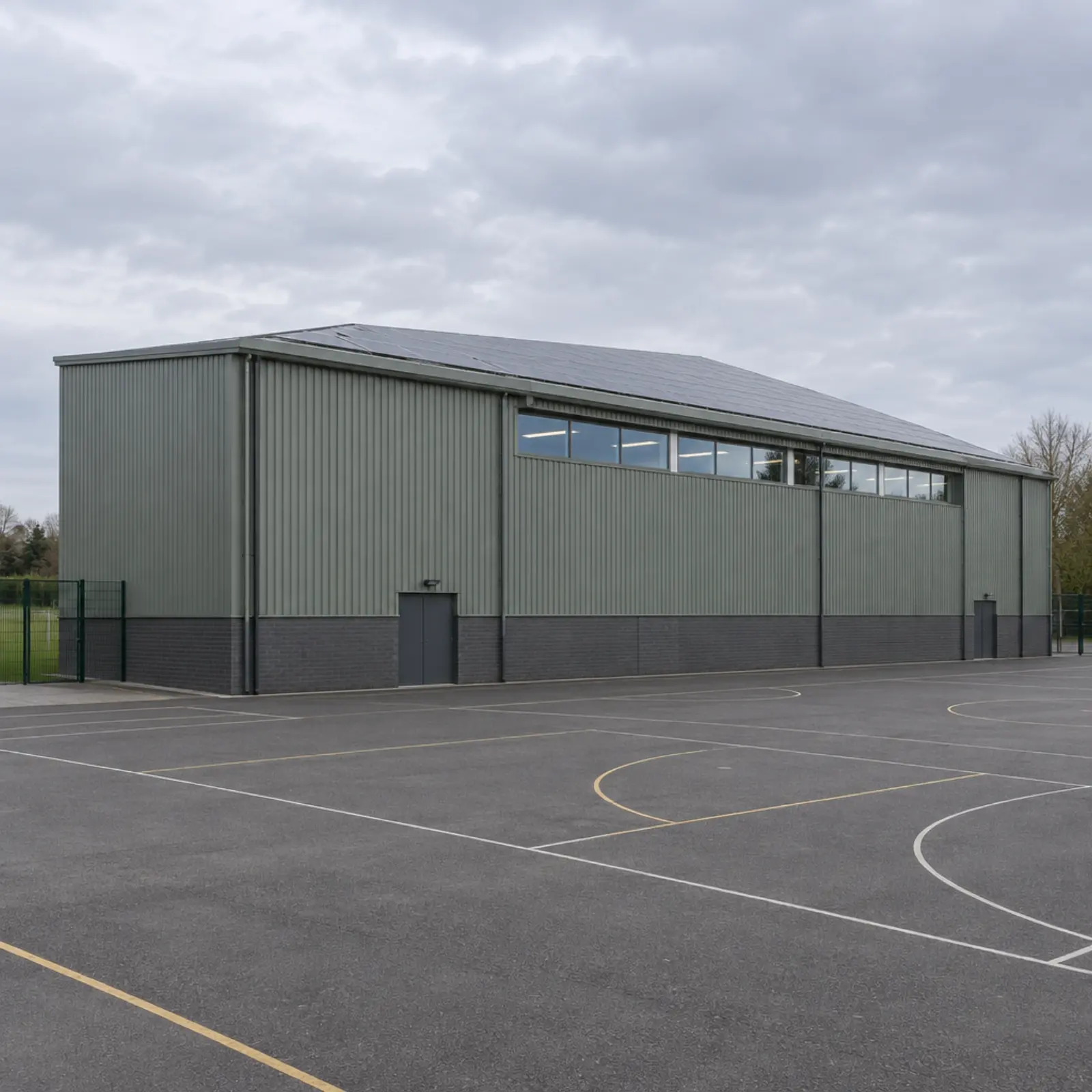
The power purchase agreement pilot, region by region
The pilot covers up to 150 schools and colleges across Yorkshire and Humber, the East Midlands and the South East. The publication says final selection would conclude at the end of the summer with procurement starting in autumn 2026, and describes the provider as retaining responsibility for maintenance and performance throughout the agreement. It does not state the term length or what happens to the panels at the end of the agreement, which is why we list both as questions to ask rather than facts to quote.
Schools outside those three regions are not shut out, but the route changed on 15 July 2026. The department says non-pilot cases will be dealt with by the School Land Transaction Team, that cases submitted up to and including 15 July 2026 continue to be considered on the terms under which they were submitted, and that cases submitted after that date will only be considered for approval where the approved PPA and land lease templates are used. If a company brings your trust its own agreement, that is the first question to put to it: a provider's own drafting is not the approved template, and the approval sits with the department rather than with the company.
- The Department for Education pays the capital cost
- The school owns the array
- The school uses the generation and pays nothing for it
Export earns the Smart Export Guarantee rate the supplier sets
- The school pays from devolved formula capital, pooled or carried forward
- The school owns the array
- The school uses the generation and pays nothing for it
Same export position, and the capital is spent once
- A private provider pays the capital cost
- The provider owns and maintains the array
- The school buys the generated units at a pre-agreed rate for the term
The provider takes the export position and the residual value
Which public sector grants funded solar, and where Salix Finance stands now
Salix Finance delivers public sector energy grant schemes on behalf of central government, and the two a school could once apply to, the Public Sector Decarbonisation Scheme and the Low Carbon Skills Fund, are both closed.
The Public Sector Decarbonisation Scheme was the main route, and Salix Finance names schools and academies among the public sector bodies it served alongside hospitals, universities, local authorities and emergency services. Phase 4 launched in September 2024, the portal opened at 2pm on 9 October 2024 and closed at 2pm on 25 November 2024, and it makes capital funding available across financial years 2025 to 2026 through 2027 to 2028 with projects completing by 31 March 2028.
It has not been renewed, and the Department for Education has said so in writing. Its Condition Improvement Fund guidance for applicants states that following the 2025 Spending Review the government has made the decision to commit no further investment for the PSDS beyond currently awarded projects. There is no Phase 5. If your trust holds a Phase 4 award it is live and running; if it does not, there is nothing to apply to.
It is also worth correcting what PSDS did when it was open, because a great deal of school solar marketing still misrepresents it. The scheme was led by heat, not by generation. The building being treated had to have a heating plant coming to the end of its useful life at ten years or older, and energy efficiency measures, the category solar panels fell into, were only eligible for funding if they were installed in a building served by a Public Sector Decarbonisation Scheme funded low carbon heating source. A school asking PSDS to fund solar on its own would never have qualified.
The Low Carbon Skills Fund, the companion Salix scheme, paid for the specialist advice behind a heat decarbonisation plan rather than for any equipment. Phase 5 provided up to £16 million for the 2024 to 2025 financial year and is closed for applications, and Salix states that there will be no funding for the Low Carbon Skills Fund in financial year 2025 to 2026. A school that was planning to use it to fund a feasibility study has to find another way to pay for one.
The practical consequence of both closures is that PSDS no longer belongs in a school's solar plan at all. If a proposal in front of your board still cites PSDS as the funding route, it was written before the 2025 Spending Review and every other figure in it should be checked on the same basis. Where PSDS does still matter is inside a trust that holds an award: those projects run to the Phase 4 rules, they install low carbon heating first, and any panels sit in a building that heating source serves.
Why the Condition Improvement Fund is not the answer either
Schools in single and small academy trusts, CIF eligible voluntary aided bodies and sixth form colleges bid into the Condition Improvement Fund rather than receiving School Condition Allocations directly, so it is the fund they reach for. Solar generation is not a priority in any of its published bands. The highest priority covers compliance, health and safety, and the critical replacement of coal fired heating with low carbon alternatives where there is a risk of closure. High and medium priority cover life expired condition replacement. The guidance then closes the obvious workaround by saying that works to improve energy efficiency, such as lighting projects, which do not involve works to address high need condition issues, are unlikely to be successful because they have a lower priority.
The one place a solar element can help a CIF bid is as supporting detail rather than as the project: applicants are expected to consider energy efficient and environmentally sustainable options when replacing components, so a roof covering bid that shows the trust intends to install an array on the renewed deck afterwards is answering a question the assessors ask. It will not improve the bid's priority band. It will show the estate is being planned rather than patched.
The 2026 to 2027 round closed at 12 noon on 16 December 2025 and outcomes were announced on 22 May 2026. No 2027 to 2028 round is announced as at 22 September 2026. Where CIF genuinely helps a solar project is sequencing: a funded roof covering or electrical systems project puts up the scaffold and renews the board that an array would later connect to, which makes the panels cheaper and safer to add afterwards out of the school's own capital. That is covered properly on our funding page.
Source: DfE, Condition Improvement Fund 2026 to 2027 information for applicants, published 21 October 2025. Checked 22 September 2026.
Where community energy and a community benefit society fit
A community energy project is one where a local community benefit society raises share capital from local investors, installs generation on a host building such as a school, and sells the electricity to that host under an agreement, returning a share of the surplus to the community.
For a school the arrangement looks structurally like a power purchase agreement and is usually gentler in its terms. The society finances and owns the array, the school grants it access to the roof and buys the units it generates, and the difference is what happens to the margin: instead of a commercial return to a funder it goes back into a community benefit fund, often with a proportion earmarked for the host school itself. A number of English schools have solar on that basis.
It is still not a grant, and the same four questions apply. What is the term, what is the rate and how does it escalate, what lease or licence does the society need over the roof, and what happens at the end. The advantage over a commercial offer is that a community benefit society publishes a share offer document setting out exactly how the project is financed and what it promises its investors, so a school can read the economics rather than infer them. Ask for it.
Two practical cautions. A community energy scheme still needs the roof to be sound for the life of the array, so the survey comes first for the same reason it does everywhere else on this site. And an academy trust granting any interest in its land has its own consent and governance obligations under the Academy Trust Handbook, which is a conversation for the trust's solicitor and its board well before a heads of terms is signed.
Loans, donations and the things schools try next
When the grants run out, three other routes get suggested and each deserves a plain answer. Green business lending is debt: it is repayable with interest whatever the product is called, and an academy trust's ability to borrow at all is constrained by the Academy Trust Handbook, so the finance director and the board need to be in that conversation from the start rather than presented with a signed proposal.
Donations and fundraising are a genuine part of how some school arrays have been paid for, usually as a contribution rather than the whole cost. A parent teacher association raising toward a specific, costed, surveyed scheme is a much easier ask than one raising toward an idea, which is another argument for doing the survey before the fundraising rather than after it. Local authority climate funds and charitable trusts occasionally run small capital rounds that a school can apply to, and they are worth a call to the authority's sustainability team, but they are local and they come and go.
The third route is the one that works most often and gets least attention: reduce what the array has to cost. A scheme sized to the school's genuine daytime consumption rather than to the available roof area costs less, exports less at the lower rate, and pays back faster. Our cost page sets out what actually moves the capital figure, and the calculator gives a first pass at the size before anyone visits.
Which capital route is open depends on what kind of school you are
The discriminator for school solar funding is the type of body, because a local authority maintained school, a large academy trust, a small trust or sixth form college and an independent school sit in four different places in the capital funding system.
Follow your own branch below. Three of the four lead to capital that the school or its responsible body already holds or can bid for, and none of those is a solar grant. The fourth leads to no public funding at all. Two central programmes cut across the first three, and a school is selected into them rather than applying.
What kind of school are you?
-
A local authority maintained school
Community, foundation and voluntary controlled schools, whose responsible body is the local authority
Devolved formula capital, allocated to the school itself. The local authority receives the DFC payments for its maintained schools and is required to pass those allocations on, and it cannot vary the formula between them. School Condition Allocations sit with the authority, which is automatically eligible for them and prioritises condition spend across its estate. You do not bid into the Condition Improvement Fund. The guidance neither names nor excludes solar PV, and describes DFC as capital funding for the school's own priorities including improvements to buildings.
DfE, Condition funding methodology and spend guidance 2026 to 2027, checked 22 September 2026
-
An academy trust above the size threshold
A trust with five or more open schools at the start of September 2025 and at least 3,000 pupils counted in the spring 2025 census or the 2024 to 2025 ILR
Devolved formula capital for each school, paid by the DfE rather than through a local authority, plus School Condition Allocations paid directly to the trust. SCA may be carried over up to an amount equivalent to 100 percent of the 2026 to 2027 allocation into 2027 to 2028, and its stated purpose includes improving environmental sustainability alongside condition, compliance and safety. Enrolment in SCA is automatic on size, so a trust in this branch cannot opt out to bid into CIF instead.
DfE, Condition funding methodology and spend guidance 2026 to 2027, checked 22 September 2026
-
A single or small academy trust, a voluntary aided body or a sixth form college
Bodies below the SCA size threshold, which receive no directly paid School Condition Allocations
Devolved formula capital, plus the right to bid into the Condition Improvement Fund for a named project. The 2026 to 2027 round closed at 12 noon on 16 December 2025 and outcomes were published on 22 May 2026, no 2027 to 2028 round is announced, and the DfE has said it is introducing a new programme from autumn 2028 to replace CIF so that bodies no longer need to submit full bids. Solar generation is not a project type in any CIF priority band, and the guidance says sustainability and energy efficiency must not be the sole justification for a replacement.
DfE, CIF 2026 to 2027 information for applicants; DfE, Education Estates Strategy, 16 February 2026, checked 22 September 2026
-
An independent school
Any fee charging school, outside the state funded system
No capital allocation and no public grant. Devolved formula capital, School Condition Allocations, the Condition Improvement Fund, the Great British Energy Solar Partnership and the Renewal and Retrofit Programme are all part of the state funded system, and the Salix Finance schemes are for public sector bodies. An independent school is in the same position as a commercial building owner, with one difference worth knowing: unless it has a genuinely trading position to set allowances against, the corporation tax relief a commercial solar proposal leans on will not arrive either. What applies instead:
- its own reserves The same decision a commercial building owner makes, and the only route that leaves the school owning the array outright with no counterparty.
- a power purchase agreement A provider finances, installs, owns and maintains the panels and the school buys the electricity at a contracted rate. Real, sometimes sensible, and not a grant.
- community energy A community benefit society raises share capital locally, installs on the roof and sells the school the power, returning a share of the surplus to the community. A lease plus a supply contract, published in a share offer document you can read.
- borrowing Repayable with interest, and generally unregulated business lending. A loan is not a grant, whatever a round up page calls it.
- the Smart Export Guarantee Income per exported unit at a rate the supplier sets, not the government. It improves a scheme rather than rescuing a weak one, and on a school it earns most in the holidays.
AND CUTTING ACROSS THE FIRST THREE BRANCHES, BY SELECTION ONLY
- Great British Energy Solar Partnership Government funded panels on state funded schools and colleges, which the school then owns. Targeted at buildings able to accommodate panels in the areas of England most in need, clustered in areas of deprivation with at least 10 schools in each region. There is no application form and no portal: the department selects and contacts the school.
- Renewal and Retrofit Programme Backed by £710 million to 2029 to 2030, with phase one from 2026 to 2027 in Yorkshire and the Humber, the East Midlands and the South East. Phase one interventions include installing solar photovoltaic panels where sites are suitable. The published guidance says the programme is not open to bids and that schools and colleges are selected by the DfE based on condition need.
gov.uk, Great British Energy solar news releases and the Renewal and Retrofit Programme publication of 15 June 2026, checked 22 September 2026
The Renewal and Retrofit Programme is the other route that funds panels
The Renewal and Retrofit Programme is a Department for Education capital programme backed by £710 million to 2029 to 2030 that tackles significant condition projects and supports decarbonisation, and installing solar photovoltaic panels where sites are suitable is one of its named phase one interventions.
It is the most important thing on this page that almost nobody is talking about, because it is the only current DfE programme outside the Great British Energy work where solar PV appears by name in the published scope. The first phase, from 2026 to 2027, is focused on schools and colleges in Yorkshire and the Humber, the East Midlands and the South East, and the Education Estates Strategy sets out an intention to extend it to all regions of England.
Like everything else that works in this area, it is not a fund you apply to. The publication says plainly that the programme is not open to bids and that schools and colleges are selected by the Department for Education based on condition need. That is also why it is worth knowing your own condition position: the same selection criteria drive the power purchase agreement pilot, and the three pilot regions are the same three regions.
The department's own estimate of the prize, published in the Education Estates Strategy, is that the school estate has around 55 million square metres of roof area with the potential to support an additional estimated 0.8 to 1.9GW of solar power, and that a typical school could save up to £25,000 per year if it had solar panels with complementary technologies installed such as batteries. Treat that last figure as what it is, a departmental estimate for a typical school with panels and storage together, not a number to apply to your own site before a survey.
A claim doing the rounds that no government page supports
Commercial installer sites are currently telling schools that applications are open for a 2026 round of the Great British Energy solar programme, and at least one publishes an application guide for it. No gov.uk or Great British Energy page says schools can apply, and none publishes a form, a portal or a window. The published position is the opposite: the government has selected schools, targeted at buildings able to accommodate panels in the areas of England most in need, clustered in areas of deprivation with at least 10 schools in each region.
We flag it specifically because it is the exact failure mode this page exists to prevent. A school business manager who believes there is an application open will wait for a window that does not exist, and will spend the intervening months not doing the survey that would have told them whether there is a project at all. If a company offers to submit your application, ask it for the gov.uk page the application lives on.
Independent schools, sixth form colleges and further education
Eligibility for school solar funding follows the funding system a school sits in rather than the building it occupies, so an independent school, a sixth form college and a maintained primary school are in three different positions.
A maintained school and an academy are inside the state funded system and receive devolved formula capital, sit under a responsible body that may receive School Condition Allocations, and are in scope for the Great British Energy Solar Partnership. Sixth form colleges are in the system but treated differently: they do not receive directly paid School Condition Allocations and instead bid into the Condition Improvement Fund, where their minimum project threshold is £50,000 against £20,000 for primary and special schools. Further education colleges have their own capital funding arrangements, which the gov.uk further education capital funding guidance covers.
An independent school receives none of it. Salix funding for the public sector has excluded schools funded privately or by charities, and none of the Department for Education's capital allocations reach a fee charging school. That leaves reserves, borrowing, a power purchase agreement or a community energy arrangement, which is the same menu a commercial building owner works from. The one thing an independent school should not assume is the commercial tax argument: unless it has a genuinely trading position to set allowances against, the corporation tax relief a commercial solar proposal leans on will not arrive there either, and the point is treated in full on our funding page.
Education funding is devolved across the United Kingdom, so every English scheme on this page stops at the border. Schools in Scotland, Wales and Northern Ireland work to their own capital systems and their own energy programmes, and we deliberately do not list windows for them here: they change faster than any commercial page updates, and a page telling a school a closed scheme is open costs it more than a page that sends it to the source.
How to check a claim that a scheme will pay for your panels
A funding claim is checkable in four steps, and a claim that fails any of them is marketing rather than a scheme a school can plan around.
First, name the funding body. A real scheme is run by a named body, the Department for Education, Salix Finance, a local authority or a named charitable trust, and that body publishes it. Second, find the page. A scheme with no gov.uk, Salix or funder page setting out its conditions of grant is not a scheme. Third, read the eligibility rather than the headline: the Public Sector Decarbonisation Scheme was open to schools and still would not have funded solar on its own, which is a distinction no round up page makes. Fourth, check the window, and check it today, because the two most quoted school energy schemes in circulation have both closed.
We apply that test to our own page, which is why every claim above carries a source and a check date of 22 September 2026. Treat any commercial page listing school solar grants as out of date until proven otherwise, including this one, and go to the source before you commit a budget or a lease.
Lenzie Consulting Ltd arranges the survey, the design and the installation through an MCS-certified partner. We are not authorised or regulated by the Financial Conduct Authority and we do not give financial, tax, legal or funding advice. We are not grant agents, we do not submit bids, and we are not a Department for Education funding body. Any power purchase agreement, lease or borrowing should be reviewed by the school's or trust's own solicitor and approved through its own governance before signature.
Get the survey done before anyone offers you free panels
Send the postcode and a rough idea of the site. We come back with what each roof can carry, what it would generate against the school's own consumption across the year, and what the capital cost looks like, so you can price any offer against the alternative of simply buying it.
No survey fee and no obligation to proceed.
Questions about solar panels for schools grants
- Can schools get free solar panels?
- Some schools genuinely have, and not by applying. Under the Great British Energy Solar Partnership the Department for Education has funded panels on selected schools and colleges, which the school then owns: as at the 16 July 2026 announcement, 245 schools and colleges had government funded solar and 100 more were announced, backed by up to £40 million. Schools do not apply for that and the department selects and contacts them. Everything else marketed as free solar panels for schools is a power purchase agreement, under which a private provider finances, installs, owns and maintains the panels at no upfront cost and the school buys the electricity generated at a pre-agreed rate, usually lower than standard grid tariffs. That is a real and sometimes sensible route, and it is not free: the provider recovers its capital and its margin through the electricity price across the term of the agreement. Sources: gov.uk, government solar drive news release and the power purchase agreement pilot publication, both 16 July 2026, checked 22 September 2026.
- Who is eligible for solar panel grants?
- For schools in England there is no open grant scheme you can apply to for solar panels as at 22 September 2026. The Great British Energy Solar Partnership selects schools rather than taking applications. The Public Sector Decarbonisation Scheme, which was the main public sector route and covered schools and academies, closed its Phase 4 window on 25 November 2024, and the government has committed no further investment for it beyond currently awarded projects following the 2025 Spending Review. The Low Carbon Skills Fund has no funding for financial year 2025 to 2026. The Condition Improvement Fund is open to single and small academy trusts, CIF eligible voluntary aided bodies and sixth form colleges, but solar generation is not a priority in any of its published bands. The funding a school can actually use is its own devolved formula capital, covered on our funding page.
- What are some grants available for schools in the UK?
- In capital terms the honest list for an English school is short: devolved formula capital, which is allocated to every eligible institution annually and paid as a single payment in June; School Condition Allocations, which go to local authorities and to academy trusts and voluntary aided bodies above the size threshold; and the Condition Improvement Fund, which the smaller trusts, VA bodies and sixth form colleges bid into. Those three are the school capital funding system. Beyond them there are sector and subject specific funds, local authority and charitable trust grants, and donations raised by the school itself, none of which is designed for a solar array. Education funding is devolved, so schools in Scotland, Wales and Northern Ireland work to different systems and the English schemes on this page do not apply to them.
- What is the 20 percent rule for solar?
- We can find no 20 percent rule in UK solar regulation that applies to a school array, and we would treat anyone quoting one as a reason to ask which document they mean. The phrase circulates mainly in United States solar marketing, where it generally refers to sizing rules in the National Electrical Code that have no UK equivalent. The rules that genuinely bind a school installation here are the network connection rules: an installation above 3.68kW per phase runs under G99 rather than G98, the distribution network operator sets the export limit, and that application is the long pole in the programme. The other number that actually decides a scheme is the proportion of generation the school consumes on site rather than exports, which on a school load profile is the whole question and is not a fixed percentage.
- Is a solar power purchase agreement good value for a school?
- It can be, and the test is arithmetic rather than principle. Under a power purchase agreement the school pays nothing upfront, the provider owns and maintains the system, and the school buys the generated units at a contracted rate. The value question is the gap between that rate and what the school would otherwise pay to import, multiplied by the units it actually consumes on site, across a term that is typically long. Against that sits what the school gives up: the units it would have had for nothing had it bought the array outright, a lease over part of its estate, and the contractual obligations that come with both. The Department for Education's own pilot publication describes the provider as retaining responsibility for maintenance and performance throughout the agreement, and does not state the term length or what happens at the end, which are the two questions to put in writing before signing anything.
- Can a school arrange its own power purchase agreement outside the pilot?
- The Department for Education's publication says non-pilot cases will be dealt with by the School Land Transaction Team, that cases submitted up to and including 15 July 2026 continue to be considered on the terms under which they were submitted, and that cases submitted after 15 July 2026 will only be considered for approval where the approved PPA and land lease templates are used. In practice that means a school or trust outside Yorkshire and Humber, the East Midlands and the South East is not shut out, but it is being pushed onto standard documents rather than a provider's own. If a company offers your school an agreement drafted on its own paper, ask how it sits with the approved templates before you take it to your board. Source: gov.uk, funding for installing solar photovoltaic panels on schools and colleges, published 16 July 2026, checked 22 September 2026.
- Do independent schools get the same solar funding as state schools?
- No. Devolved formula capital, School Condition Allocations, the Condition Improvement Fund and the Great British Energy Solar Partnership are all part of the state funded system and an independent school receives none of them. Salix funding for the public sector has likewise excluded schools funded privately or by charities. An independent school is in a similar position to a commercial building owner: it funds an array from its own reserves, from borrowing, or through a power purchase agreement, and unlike a commercial company it is unlikely to have a meaningful corporation tax position to claim allowances against. The engineering is identical, the roofs are often better, and the funding conversation is simply a different one.
- Does the Smart Export Guarantee count as funding for a school?
- It is income rather than funding, and it arrives only after the array is generating. The Smart Export Guarantee, administered by Ofgem, requires larger licensed electricity suppliers to offer a tariff for units exported to the grid. Solar PV is an eligible technology, installations up to 5MW can take part, and payments are calculated from export meter readings. The suppliers rather than the government set the rate, so there is no national figure to quote and shopping around is part of the job. For a school it matters more than for most buildings, because the generation peaks in the summer holidays when the site is closed, so a larger share of the output is exported at the lower rate than a year round business would see. That is a design question, answered at survey, not a funding question.