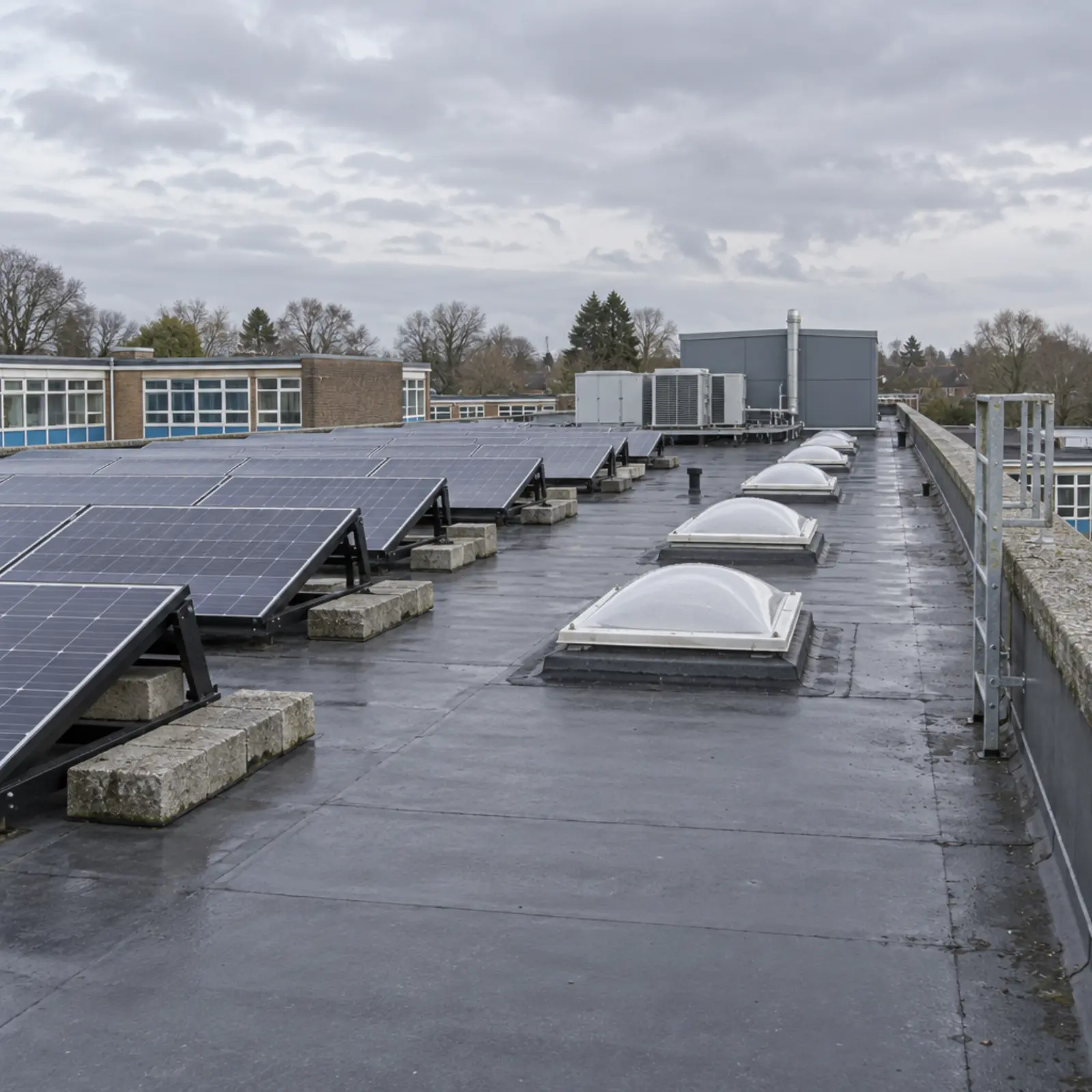
What a school roof would make, and how much of it you would use
Generation is the easy half of the sum and it is the half every calculator gets right. The
half that decides whether a scheme is worth doing is what share of that generation a school
uses at the moment it is made, and on a school that share is structurally lower than on a
warehouse. This calculator puts the assumption on the screen instead of hiding it inside the
answer.
Why solar panels for schools need a different sum
A school buys electricity on a different rhythm from a warehouse. Maintained schools in
England must be open to pupils for at least 190 days a year under the Education (School Day
and School Year) (England) Regulations 1999, and academies broadly follow the same shape.
That leaves the buildings shut for the other 175 days, and those days are not spread evenly.
Six of the weeks fall across late July and August, which is the highest yielding stretch of
the year.
We can put a figure on that. Taking the EU PVGIS v5.2 monthly generation profile for each of
the 397 towns we hold one for, and weighting it by a 191 day school year,
only 49 percent of a year's generation lands on a day a term
time only school is open at all. The figure runs from 49 to 50 percent across
the whole country, so this is not a southern problem or a northern one. It is the shape of the
school year. The summer break alone accounts for about 16 percent of the year's
output, and the buildings are empty for all of it.
The second effect sits inside the day. A school's load falls away from about three o'clock,
while the array carries on generating until dusk. In June that tail is long. So even on an
open day, a roof sized array pushes more into the grid than a building working two shifts
would. Neither effect is a reason not to do it. Both are reasons to size the array against
the load rather than against the roof, and to be honest about the split before anyone signs
anything.
Usable area is what survives rooflights, plant, walkways and the setback from a parapet. On a flat roof the ballast and tilt frames take more of it again.
Size school rooftop solar against your own term dates
The calculator reads the modelled yield for your own town rather than a national average,
because across the 397 towns we cover that figure runs from 704 to 1028 kWh
per kWp a year, a spread of about 46 percent. Enter the roof area, or the array size
if a designer has already given you one, and the annual electricity figure from your
supplier's statement. Then tell it how the buildings are used out of term, which is the input
that moves the answer most.
One conversion is worth stating plainly, because a lot of calculators get it wrong in the
optimistic direction. A kWp is rated at 1,000 watts per square metre of sunlight, and a
commercial module converts roughly a fifth of what lands on it, so a kWp needs about five
square metres of roof when panels sit flush on a pitched or shallow slope. On a flat roof the
rows have to be tilted and spaced so they do not shade each other, which pushes it to around
seven and a half. A 1960s teaching block therefore carries a good deal less array than its
footprint suggests, and any tool that tells you otherwise is quietly inflating every figure
downstream of it.
MONTH BY MONTH, PER kWp INSTALLEDBolton
made on a day the buildings are in use
made while they are closed, so almost all of it exports
What the self-consumption default assumes, and why
Self-consumption is the share of generation a site uses at the moment it is made, and on a
rooftop scheme it is what the whole appraisal turns on. Electricity used on site displaces
electricity you would otherwise buy at your delivered day rate. Electricity exported earns a
rate set by your supplier that is materially lower. Two schools with identical roofs and
identical arrays can sit a long way apart on payback purely because one of them runs a pool
and the other locks up on the third Friday in July.
The default here is built from two steps and one stated assumption, all of them visible in
the calculator rather than folded into a single constant:
1
Availability. What share of the year's generation falls on a day the
buildings carry a load. Computed from the PVGIS monthly profile for your town against the
school calendar. Term time only comes out near 49 percent. Some holiday use
lifts it. A pool or a nursery running all year lifts it further.
2
Match. Of the generation landing on those days, how much is absorbed at
the moment it arrives. A small array is taken almost entirely. A roof sized array meets
the ceiling of the daytime load and the surplus goes out to the grid, so the curve
flattens as the array grows.
3
The stated assumption. We take 60 percent of a school's annual
electricity as falling in the daylight hours of days it is open. That is the one number
in the model that is a judgement rather than a measurement, and the survey replaces it
with twelve months of your own half hourly data.
The model is deliberately conservative in one direction. It counts generation on closed days
as entirely exported, when in practice servers, fridges, frost protection and security
lighting keep a small load running through the holidays. So the measured figure normally
comes out a little above the modelled one. We would rather the surprise at survey were in
that direction.
How the Smart Export Guarantee prices everything you cannot use
The Smart Export Guarantee obliges larger licensed electricity suppliers to offer at least
one tariff that pays for exported electricity. It replaced the export element of the Feed in
Tariff for new installations from January 2020. Ofgem administers the scheme and reports on
it, and this is the part that catches people out: Ofgem does not set the rate. Each supplier
sets its own price, structure and terms, and the offers vary widely, which is why no export
figure is printed anywhere on this site. You put your own in, or you leave the field blank
and read the kWh.
Two practical points follow for a school. The first is that an export rate sits well below
what the site pays to import, so a kWh exported is worth a fraction of a kWh displaced. That
is the arithmetic that makes availability matter more than headline generation. The second is
that eligibility depends on the installation being certified under the Microgeneration
Certification Scheme or an equivalent scheme for the size of the array, which is one of
several reasons the installation is carried out by an MCS-certified partner rather than by
us. If the school buys its electricity through a public sector framework, the export
arrangement may need to be agreed alongside it, and that is worth raising early.
Four things that move the answer more than the panels do
Battery storage moves generation across time rather than creating more of it. That is a real
gain and a limited one, and it is the first of four levers that matter more than the choice
of module.
Sizing to the load, not the roof
The single largest lever, and the cheapest. Every kWp added past the point where midday
output meets the daytime load earns an export rate instead of a saving. The sizing strip
in the calculator shows the taper live: cut the array and the used on site percentage
climbs.
Battery storage
A battery carries the after three o'clock generation into the evening load and, sized
larger, a weekend into the following week. It cannot carry July into October, so it
improves the term time picture rather than the summer one. The Department for Education's
own Education Estates Strategy of 16 February 2026 estimates that a typical school could
save up to 25,000 pounds a year with solar panels and complementary technologies such as
batteries installed. Read the conditional in that sentence, because it is doing the work:
it is an estimate with the battery attached, not a figure panels reach alone.
Holiday period use
Lettings, a summer play scheme, a community pool, a nursery, a kitchen producing for
another site: anything that puts a load in the building in August changes the economics
more than any equipment decision. If the trust is already considering it, model it before
you size the array.
Where the meters sit
An array on a sports hall serves the sports hall's meter first. Sites with several supply
points, or a leisure block on a separate account, often find the constraint is the wiring
between buildings rather than the roof. The survey maps that before a layout is drawn.
Work out your devolved formula capital from the pupil roll
Devolved formula capital is an annual allocation a school receives to spend on its own
capital priorities. The Department for Education publishes the formula it is calculated
from, which means you can work out your own figure rather than waiting to be told it. For
2026 to 2027 it is four thousand pounds per school plus eleven pounds twenty five for every
weighted pupil, where primary pupils count once and secondary pupils count one and a half
times, multiplied by 1.08 for voluntary aided schools only.
The panel below is that formula and nothing else. It is arithmetic from a published source
rather than a model, so unlike the array calculator above it carries no assumptions of ours
at all. It opens on the Department's own worked example of 50 primary and 500 secondary
pupils. Switch the type selector to voluntary aided and it returns 14,040 pounds, which is
the figure printed in the guidance, so you can check our arithmetic against the source
before you trust anything else on this page.
Three points of detail matter for planning. The allocation is paid as a single payment in
June. It can be spent across three financial years, the first being the year it is paid, so
it does not have to be committed in the year it arrives. And academies within a trust can
pool their allocations with each other's agreement, which is what turns a set of small
per school figures into a number large enough to do something structural with.
One thing we will not tell you is whether this can be spent on solar. The condition funding
guidance does not name solar, photovoltaics, renewables or decarbonisation anywhere in its
devolved formula capital provisions, so it neither permits nor prohibits it by name. What it
does say is that the allocation is for the school's own capital priorities, which the school
itself sets. That is a question for your responsible body and your auditors, not for us, and
anyone telling you the answer is a straightforward yes is going beyond what the guidance
says. Our funding page sets out the capital and grant routes in
full, including the ones that do name this kind of work.
Solar PV for academy trusts running several sites
An academy trust holds several sites under one set of accounts, and that changes the
question. A single school asks whether its own roof works. A trust asks which of its roofs
works first, and the answer is rarely the largest one. It is usually the site with the
highest daytime baseload against the roof it has, which in practice means the site with a
pool, a commercial kitchen, a data room or an attached nursery.
Run the calculator once per site and compare the used on site percentages rather than the
generation figures. A 400 kWp array holding 30 percent and a 150 kWp array holding 45 percent
are very different propositions once the export rate is applied, and the smaller one often
reaches a governors' meeting in better shape. Our roof survey page
sets out what gets measured, and the procurement page covers how
this is bought under public procurement rules.
Questions about this school solar calculator
Why does a school need a different solar calculator?
A school is open to pupils for about 191 days of 365, and the days it is shut fall in the sunniest weeks of the year. Across the towns we hold a modelled profile for, only 49 to 50 percent of a year's generation lands on a day a term time only school is open at all. A calculator built for a warehouse assumes the building is working through daylight all year and applies a self-consumption figure to match. Run that assumption on a school and the saving comes out roughly double what the site would actually see.
What self-consumption figure should a school use?
There is no single right number, which is why this calculator shows the one it used and lets you change it. The modelled figure falls out of three things: what share of generation lands on a day the buildings are in use, how large the array is against the site's daylight demand, and whether anything runs through the holidays. On a term time only site with an array sized to the roof it commonly lands near a third. Sizing the array down, or letting the buildings in August, moves it up.
What happens to the electricity a school cannot use?
It is exported to the grid and paid for under the Smart Export Guarantee, which obliges larger licensed electricity suppliers to offer at least one export tariff. Ofgem administers the scheme but does not set the price: each supplier sets its own rate and terms, and they vary, so we publish none here. The rate offered is materially below what a school pays to import, which is why the split between used and exported decides the appraisal rather than the headline generation figure.
How accurate is this estimate?
It is arithmetic against a modelled yield, rounded to three significant figures, and it is meant as a sense check before anyone spends money on a survey. It knows the irradiation at your latitude and how roof area converts into array size. It does not know your purlin centres, your roof's remaining life, whether there is RAAC above a ceiling, what shading falls from a taller block in October, or what the network operator will let you export. Those are what decide a real scheme, and they are what the survey is for.
Does the calculator include a price?
No. Price per kWp moves with roof condition, access, the mounting system a flat roof needs, the grid application and the state of the market on the day, so any figure published here would be a guess wearing the clothes of a quotation. What the calculator does instead is give the generation and the split, and put a value on it only at the unit rate you supply from your own bill.
How much devolved formula capital does our school get?
You can work it out exactly, because the Department for Education publishes the formula. For 2026 to 2027 it is four thousand pounds per school plus eleven pounds twenty five for each weighted pupil, with primary pupils counting once and secondary pupils one and a half times, and a 1.08 multiplier for voluntary aided schools only. The panel on this page runs that formula on your own roll. Two caveats: the Department calculates the real allocation from the spring 2025 census rather than from today's numbers, and the allocation is paid as a single payment in June that can be spent across three financial years. Source: DfE, Condition funding methodology and spend guidance 2026 to 2027, March 2026.
Can devolved formula capital be spent on solar panels?
We will not give you a yes or a no, because the guidance does not give one. The condition funding guidance does not use the words solar, photovoltaic, renewable or decarbonisation anywhere in its devolved formula capital provisions, so it neither permits nor prohibits this by name. What it does say is that the allocation is for the school's own capital priorities, and the school sets those. Whether a particular scheme fits is a decision for your responsible body and your auditors. Anyone who tells you the answer is a simple yes is going further than the published guidance does.
Would a battery change the numbers?
It can, and the calculator does not model one, because a storage appraisal needs half hourly data rather than an annual total. A battery moves generation from the middle of the day into the hours after the bell and, at a larger scale, from a weekend into the following week. What it cannot do is move a July afternoon into October, so it shifts the after hours generation rather than the six week summer break. The Department for Education's Education Estates Strategy of 16 February 2026 estimates that a typical school could save up to 25,000 pounds a year with solar panels and complementary technologies such as batteries installed, and the battery in that sentence is a condition rather than an optional extra. We size storage at survey, against real meter data, and only where the sums stand up.
Send the postcode, the rough roof area and last year's electricity figure, and we will come
back with what the buildings can carry and what the split is likely to be. No charge and no
obligation.