What school solar panels cost, and what a governing body is really buying
We are not going to put a rate per kWp on this page, because nobody can price a school from a postcode and a pupil count. What this guide does instead is set out what the cost of solar panels for schools is made of, which parts of an education estate move the number, and why the payback arithmetic on a school building works out differently from the same array on a warehouse.
no price without a survey / the quote broken into lines / your own half hourly data
How much do solar panels for schools cost in the UK?
Solar panels for schools cost whatever it takes to get an array safely onto a live education building and connected to a supply that was sized for a boiler house, so two schools with the same roof area and the same pupil numbers can be quoted very differently.
The difference is almost never the panels. It is the roof construction, the access provision, the distance from the building to the intake position and what the distribution network operator will let the school export. The cost of solar panels for schools is therefore a building specific number, and every guide that prints one rate is describing an average rather than your site.
Published figures for solar for schools are taken across a mixed population, from single storey primary schools to sixth form colleges and multi-building academy trust estates, and government guidance on buying energy measures does not print a rate either. They describe nobody's school in particular. We would rather give you the structure of the number, because once you can see the lines you can compare two quotes properly instead of comparing two headline rates built on different assumptions about scaffold. The cost savings a scheme produces are only as reliable as the installed cost the scheme starts from.
That structure is also what a responsible body needs in order to approve the spend at all. A business case that shows a single installed cost and a single savings figure gives governors nothing to test. One that shows the eight lines, names which of them the survey has fixed and which are still estimates, and states the energy assumptions openly, is a document a finance committee can actually interrogate.
What sits inside a school solar quote
A kWp, or kilowatt peak, is the rated output of a solar array under standard test conditions, and it is the unit every school solar quotation is priced against.
A school solar quote is a construction price, not a product price. What it costs to install solar panels on an education building is mostly what it costs to reach the roof safely on a site full of children, fix to whatever the roof is built from, and cable back to the intake position. Most of the variation between two quotes for the same teaching block sits in how each one handles access, the mounting design and the electrical works.
The order matters as much as the total. A quotation that prices the modules and the inverters precisely and leaves scaffold, groundworks and the grid application as provisional sums has priced the easy half. Those three lines are where the money on a school installation actually goes, and they are the ones a survey exists to pin down.
Ask for the price broken into these eight lines. It is the only way to see what you are comparing, and it is also the format that makes an internal approval straightforward, because each line can be traced back to something the survey established rather than something the supplier assumed.
Design and feasibility
Scaffold and access
Roof fixings and mounting
Modules
Inverters and monitoring
Electrical labour and containment
The grid application
Commissioning and handover
- design and survey
- access and scaffold
- grid application
- modules
- inverters
- mounting
- electrical labour
- commissioning
Figure data
| Quotation line | Share of total |
|---|---|
| design and survey | 6% |
| access and scaffold | 14% |
| grid application | 4% |
| modules | 26% |
| inverters | 12% |
| mounting | 13% |
| electrical labour | 18% |
| commissioning | 7% |
Why system size changes the price per kWp
System size is the strongest single lever on the rate per kWp, because design time, the grid application, mobilisation, scaffold and commissioning are close to fixed whether the solar system is 30 kWp or 500 kWp.
Spread those over more panels and the rate falls, which is why a long sports hall roof usually prices better than a small early years block on the same site. On a multi-building estate this is the argument for treating the whole site as one scheme rather than as a series of small installations, and for an academy trust it is the argument for treating the estate as one programme.
The effect is not unlimited. It flattens once the fixed costs are diluted, and it reverses if the system grows past what the incoming supply or the network operator will accept, because at that point the school is buying a connection upgrade as well as an array. On an urban school with a constrained supply that reversal arrives earlier than most people expect.
Sizing to the roof and sizing to the load also give different answers, and on a school they diverge further than on any other building type. School roofs will usually carry more panels than the timetable consumes. Whether the surplus is worth installing depends on the export rate, on whether battery storage is in scope, and on the arithmetic in the next section but one.
Figure data
| System size | Cost per kWp, indexed |
|---|---|
| 50 kWp | 100 |
| 100 kWp | 88 |
| 250 kWp | 76 |
| 500 kWp | 69 |
| 900 kWp | 66 |
| past the limit | 79 |
Why access and the roof move a school quote more than the panels do
Access provision and roof construction together account for more of the variation between two school solar quotes than module choice, inverter brand and system design combined.
A module is a traded commodity sold by the watt, so two suppliers quoting the same array rarely differ much on it. Getting to a roof on a safeguarded site with a live timetable is not a commodity at all. It is scaffold, edge protection, a hoarded compound, a delivery route that avoids the playground, cleared and inducted operatives, and a programme built around half terms. Those are the lines that separate a cheap quotation from a realistic one.
The roof itself is the other half. Flat single ply on a 1970s teaching block takes non penetrative ballast and a wind uplift calculation. Pitched tile on a Victorian primary takes brackets into rafters that somebody has to inspect first. A deck of uncertain construction takes a structural appraisal before anyone loads it at all, and reinforced autoclaved aerated concrete and older asbestos containing fabric are both present across the education estate in numbers. Our roof survey page sets out what gets measured and why each item matters to the price.
Roof construction and age
What the deck is made of
The compound and the working window
The incoming supply
Usable roof area after everything comes out
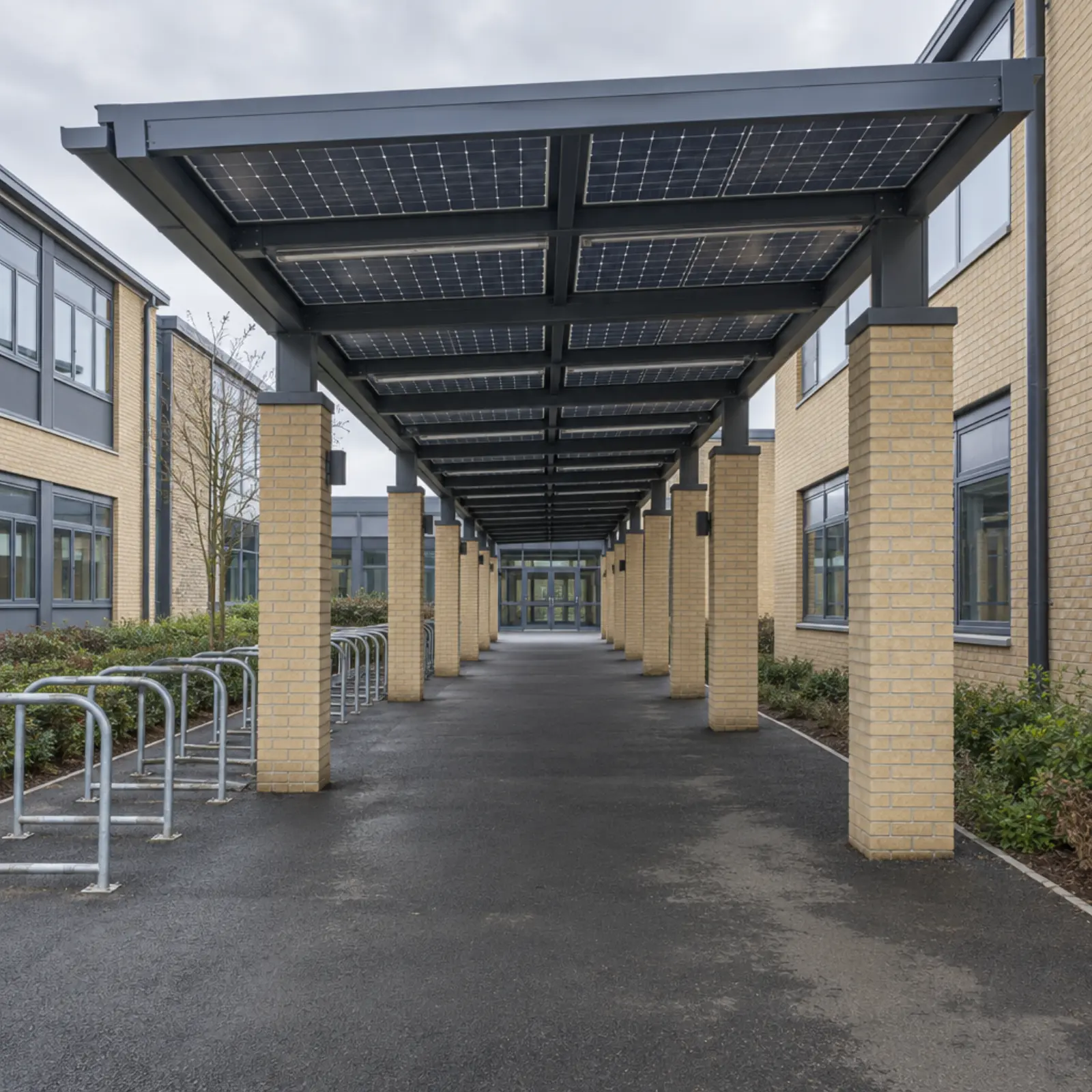
There is one structure on a school site where almost none of that schedule applies, which is why it comes up in so many first conversations. A canopy or a covered walkway is a purpose built frame with nothing underneath it to keep dry, no existing covering to survey and no occupied classroom below, so the access provision and the roof construction stop being the variables. It will not carry the array a teaching block would, and it is rarely the answer to a whole school's energy use on its own. It is a useful thing to price alongside the roofs rather than instead of them.
Why school rooftop solar pays back slower than a warehouse of the same size
A school building empties for roughly six weeks across the highest yield period of the year and its load falls away after the end of the teaching day, so a school rooftop solar array of a given size exports a larger share of its generation than the same array on a building that runs all summer.
We set that pattern out in full in our section on how term dates decide what an array is worth, so this section only carries the consequence for the money. Every unit the school uses on site is worth the delivered day rate on its energy bills, including standing and non commodity charges. Every unit exported is worth whatever the supplier offers under the Ofgem Smart Export Guarantee, which is materially lower. Shift units from the first bucket to the second and the annual benefit falls, while the installed cost does not move at all.
Run the arithmetic and the effect is straightforward. Payback is installed cost divided by annual benefit, so a school and a distribution warehouse with identical roofs, identical arrays and identical installed costs will report different payback periods purely because of when each building is occupied. That is not an argument against school solar. It is an argument for three things: modelling the split from the school's own half hourly data rather than from a sector average, taking battery storage seriously because it moves units back across the line, and looking hard at any load that can be shifted into the holidays.
The Department for Education's own estimate points the same way. Its Education Estates Strategy states that "a typical school could save up to £25,000 per year if they had solar panels with complementary technologies installed such as batteries". Read the condition in that sentence rather than the number. The figure is stated for panels plus complementary technology, not for panels alone, and the reason storage is doing work in it is exactly the demand pattern described above. It is a departmental estimate of what is possible on a typical school, not a figure any particular school is entitled to, and we would not put it in a business case as a forecast.
That is also how a saving should be presented to governors. A figure built on an assumed self-consumption share is a guess wearing a decimal point. A figure built on twelve months of the school's own meter data is a forecast somebody can defend, and it is the only version worth putting in a business case.
Why the tax position on a school is not the one a company gets
Capital allowances reduce a bill for corporation tax or income tax on trading profits, and a school or academy trust generally has no such bill against its charitable activity, so the after tax cost argument a trading company relies on mostly does not apply here.
This is where a great deal of commercial solar material misleads a school. HMRC classifies solar panels as special rate pool plant in its Capital Allowances Manual at CA22335, and for a warehouse operator or a farming partnership that classification is the start of a real conversation about the cash cost in year one. An academy trust is an exempt charity. A maintained school sits within its local authority. In both cases there is usually nothing for the allowance to reduce, and a business case that quietly assumes otherwise overstates the benefit.
The exception worth knowing is a trading subsidiary. Where a trust runs lettings or another commercial activity through a subsidiary that is within the charge to corporation tax, the position is different, and who owns the array then becomes a question with a tax answer attached. We are not accountants and we do not give tax advice. Put CA22335 and the ownership question in front of the trust's auditor before anyone signs.
VAT usually runs the other way and in the school's favour. An academy trust in England reclaims VAT on purchases relating to its non business activity under section 33B of the Value Added Tax Act 1994, which HMRC covers at VATEDU70000, and a maintained school recovers through its local authority's section 33 scheme. The practical discipline is consistency: keep the installed cost, the energy bills and the payback calculation on the same basis, because comparing a gross quotation against net savings is one of the commonest errors in a school appraisal.
What solar for education buildings costs to run after handover
Operation and maintenance is a small annual cost against the installed price, and it is the line most often left out of a school business case entirely.
The work itself is modest. Inverters are the component most likely to need attention within the design life of the panels, the array wants periodic inspection and electrical testing, and the roof penetrations or ballast need checking on the same cycle as the rest of the roof. Modern solar panel systems are largely passive, and where battery storage systems are included they carry their own service regime and their own end of life date. Monitoring matters more than cleaning on most sites, because an underperforming string is invisible without it and a school has nobody walking the roof to notice.
Two things make maintenance a school question rather than a generic one. The first is access again: every visit that needs the roof needs the same provision the installation needed, so the sensible arrangement ties planned maintenance to holiday periods from the outset. The second is who holds the obligation. Where the array is owned outright the school or trust carries it as an estate asset with a line in the maintenance plan. Where a funder owns it, maintenance sits with them under the contract, and what happens at the end of the term is a question to settle before signature rather than after. Our funding page compares those routes properly.
Monitoring also earns its keep educationally. A live generation feed is usable in science and geography teaching and in a school's own net zero reporting, which is a genuine benefit even though it never appears in a payback calculation. It is worth specifying the data output at quotation stage, because retrofitting a usable feed afterwards costs more than asking for it once.
What a school buys that never reaches the payback calculation
A governing body weighs benefits a payback period cannot express, and on an education building several of them are real enough to change the decision even where the cost savings alone would not.
The first is the net zero position. Most trusts and local authorities now carry a published net zero commitment and report against it, and generating renewable energy on site moves the reported figure in a way no energy tariff does. A renewable installation on the roof is the only measure on most school estates that a parent, a governor and an inspector can all see from the car park, which is a communications benefit as much as an environmental one. It is also the benefit most likely to be raised at a governors' meeting before anyone mentions payback.
The second is educational. Monitoring systems that expose live generation data give science and geography departments a dataset produced by their own building, and schools that specify the data feed at quotation stage rather than afterwards get educational opportunities out of the installation at close to no extra cost. Several schools run the array as a standing educational project across key stages, and the renewable energy curriculum benefits from a solar panel array the pupils can see rather than a diagram. None of that appears in a payback calculation and all of it is part of what the money bought.
The third is resilience against energy prices. A school that generates a share of its own electricity is less exposed to the next move in wholesale rates than one that buys everything, and that reduced exposure improves the stability of a budget rather than its headline. Where battery systems are included the same effect extends past sunset. We would not build a business case on any of these three benefits. We would put them in front of a board alongside the number, because pretending the decision is purely financial is how good schemes get turned down.
Where funding and the buying route change the sum
Grant funding changes the installed cost rather than the annual benefit, so it shortens the payback without altering any of the arithmetic above it.
Several routes exist and they behave differently. Devolved formula capital and the Condition Improvement Fund are capital sources a school or trust already has a claim on. Salix and the public sector decarbonisation route target energy and carbon directly. Great British Energy, the government owned company, has funded solar installations on schools and colleges in England outright, targeted by region and by deprivation, and a school selected for that government solar programme is not buying an array at all. Our grants page sets out which scheme actually funds panels and where the source says so, and our funding page covers the commercial routes.
There is also a route with no upfront cost at all, in which a funder owns the array and the school buys the clean energy it generates under a power purchase agreement. Government announced in July 2026 that it was piloting exactly that model with up to 150 schools and colleges before a wider rollout. It removes the capital question and replaces it with a contract question, and the two are not interchangeable: an upfront purchase and a long term energy agreement can produce similar cost savings on paper and very different obligations on the school. Since 15 July 2026 any power purchase agreement on the school estate has to use the Department for Education's own template, which our procurement page covers in full, and no school should sign one without reading that first.
The buying route changes the sum in a quieter way. A framework call-off with pre-agreed terms costs less to run than a full tender and takes less of a business manager's year, and the cost of running the process is a real cost even though it never appears on the installer's quotation. Getting the route right also protects the spend: an award that turns out to have been non compliant is a far more expensive problem than a slightly higher unit price. Our procurement page sets out which route applies at which level of spend, what an academy trust owes under the Academy Trust Handbook and what a maintained school owes under its local authority's rules.
Get the numbers for your own school buildings
Send the postcode and roughly which buildings you have in mind. The survey replaces this guide with figures for your own site: what each roof can carry, what the supply will take, modelled generation against your own half hourly consumption, and what the funding routes do to the payback on those numbers.
Lenzie Consulting Ltd arranges the survey and passes your details to an MCS-certified installation partner so they can quote. No survey fee, no obligation to proceed. We do not guarantee a saving and no figure on this page is a quotation.
Questions about the cost of solar panels for schools
- How much do solar panels cost for a school?
- Solar panels cost a school a figure that only a survey produces, because the price is a construction price rather than a product price. What moves it is how hard the roof is to reach safely on a live site, what the roof is built from, how far the building sits from the intake position and what the distribution network operator will allow the school to export. A published rate is taken across a mixed population of primary schools, secondary schools, sixth form colleges and academy trust estates, so it describes nobody's school in particular. Ask for the quote broken into the eight lines set out on this page and compare those, rather than comparing two headline numbers built on different assumptions about access.
- How long do solar panels take to pay for themselves?
- Payback is installed cost divided by annual benefit, and the annual benefit on a school is lower than the same array would earn on a warehouse because of when the building is occupied. A school empties for roughly six weeks across the highest yield period of the year and its load falls away after the end of the teaching day, so a larger share of the generation is exported at the Smart Export Guarantee rate rather than displacing energy bought at the delivered day rate. That does not stop the project working. It means the payback has to be modelled on the school's own half hourly meter data rather than on a commercial rule of thumb, and it means battery storage and holiday load shifting earn their keep here in a way they may not elsewhere.
- Can schools get free solar panels?
- There are two routes that put solar panels on a school roof with no capital outlay, and they are not the same thing. The first is a government funded programme: Great British Energy has funded installations on schools and colleges in England, targeted by region and by deprivation, and a school selected for one of those does not buy the array at all. The second is a commercial arrangement in which a funder owns the array and the school buys the electricity it generates under a long term contract, which government announced in July 2026 it was piloting with around 150 schools and colleges. Free on day one and free over the life of the contract are different propositions, and the second is still a procurement decision the responsible body has to make properly.
- How much money do schools save with solar panels?
- The saving is the sum of two different rates, not one. Every unit the panels generate that the school uses on site displaces a unit it would otherwise buy, so it is worth the full delivered day rate including standing and non commodity charges. Every unit exported earns whatever the school's supplier offers under the Ofgem Smart Export Guarantee, which is materially lower. Government has published figures from its own programme, and they need reading carefully: the Department for Education stated in July 2026 that secondary schools which have had solar panels installed and their lights upgraded to LED lighting are saving £58,600 a year, and primaries £21,000. Those figures cover solar plus an LED lighting upgrade, not solar alone, so quoting them as a solar saving overstates what the panels did. We ask for twelve months of half hourly consumption data before modelling anything, because a sector average is the part of most published savings figures that does not survive contact with a real school.
- Can a school claim capital allowances on solar panels?
- Capital allowances reduce a bill for corporation tax or income tax on trading profits. An academy trust is an exempt charity and a maintained school sits within its local authority, so in most cases there is no such bill for the allowance to reduce, and the relief a trading company or a farming partnership relies on simply does not carry across. HMRC classifies solar panels as special rate pool plant in its Capital Allowances Manual at CA22335, and that classification matters where a trust has a subsidiary in charge to corporation tax, for example a lettings company. We are not accountants and we do not give tax advice. Put the question to the trust's auditor before anyone builds a business case that assumes tax relief.
- Do schools pay VAT on solar panels?
- VAT is charged on the installation, but most schools are not left carrying it. An academy trust in England can reclaim VAT on purchases relating to its non business activity under section 33B of the Value Added Tax Act 1994, which HMRC sets out at VATEDU70000. A maintained school recovers through its local authority's section 33 scheme instead. The practical point for a business case is consistency: make sure the installed cost, the energy bill and the payback calculation are all on the same basis, because comparing a gross quotation with net energy savings is one of the commonest errors in a school solar appraisal.
- What is the 20% rule for solar panels?
- The 20 percent rule is an internet phrase rather than a UK rule. No legislation, no Building Regulation, no part of the network connection process and no Department for Education guidance contains one, and it circulates as a garbled version of an export limit, a self-consumption target or an American tax provision. What genuinely limits a school solar installation is the structural capacity of the roof, the usable area once rooflights and plant come out, the capacity of the incoming supply, and the export limit the distribution network operator will agree under G98 or G99.
- Does the installation have to happen in the school holidays?
- Not all of it, but the parts that matter usually do. Scaffold erection and strike, roof loading, craneage and the electrical shutdown are the operations that sit badly beside a running timetable, and most schools programme them into a half term or a summer break. Cable pulling, inverter mounting and commissioning can often continue in term time behind a properly separated compound with cleared and inducted operatives. The consequence for the cost is that a school project is programmed around fixed windows rather than around the contractor's convenience, and a quotation that ignores those windows has not been priced for a school.