Who runs this site, and the specialist part of the job we do
Lenzie Consulting Ltd publishes this site, company number 08174104, registered in England and Wales. We arrange the survey, the design and the installation through an MCS-certified partner. We are not the installer, we are not certified under the Microgeneration Certification Scheme ourselves, and nothing here should be read as saying otherwise.
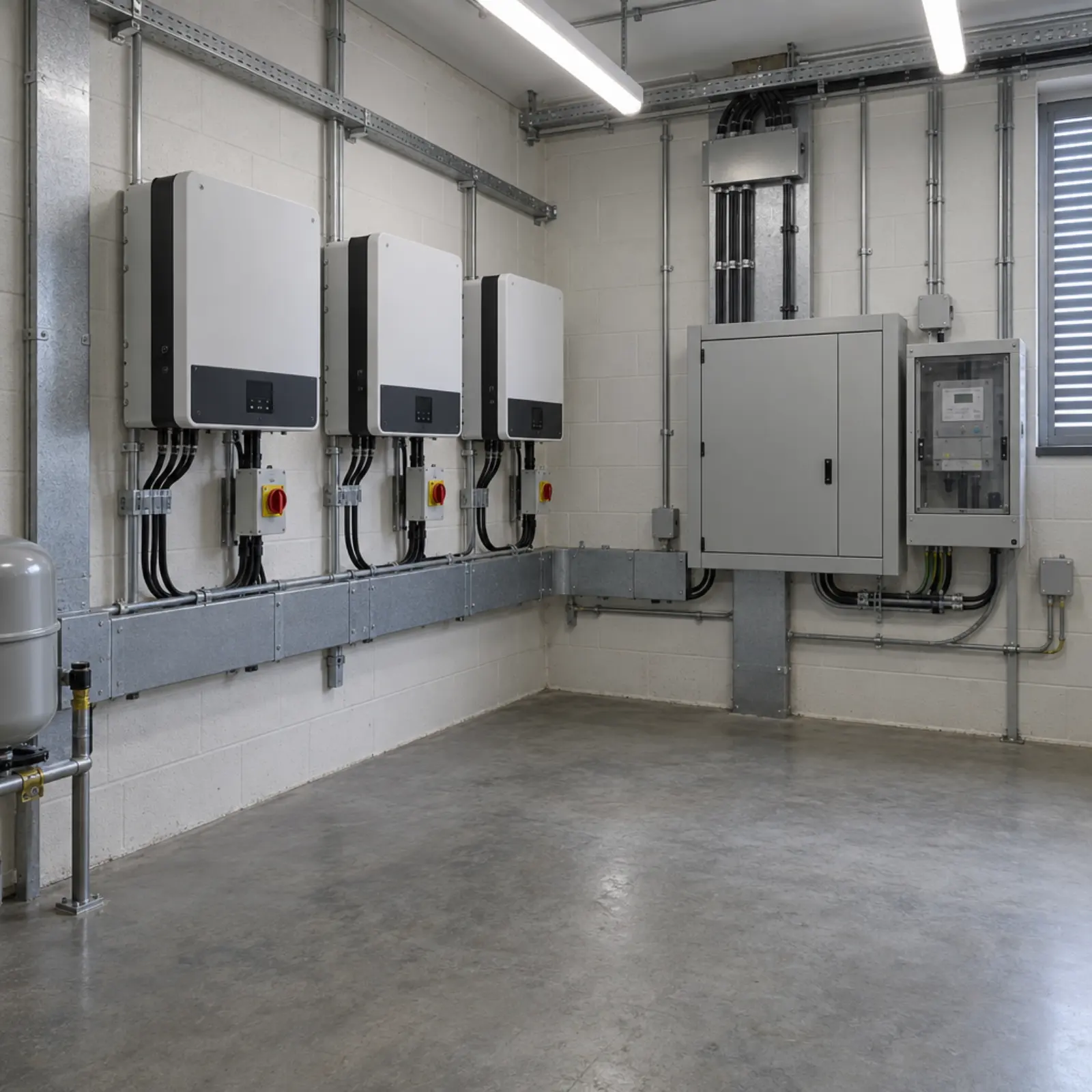
What we arrange, and what an MCS-certified partner installs
Our work sits entirely before the scaffold arrives. We take a site from an idea a business manager has been asked to look into, to a costed proposal a governing board or a trust board can make a decision on. That means the roof survey, the array layout, the yield model against your own half hourly consumption, the distribution network operator application, and a comparison of the routes to paying for it. It costs the school nothing and carries no obligation at any point.
What we do
We measure the roof and record what is on it. We model generation from the European Commission's PVGIS service at your own latitude rather than a national average. We model the split between generation used on site and generation exported, using your term dates and your meter data rather than a commercial building's working week. We make the network application and report what comes back. We set out the funding routes side by side, including outright purchase from capital, devolved formula capital, grant funded routes and a power purchase agreement, and we say which we think fits and why.
What our partner does
Design sign off, scaffold, mounting, all electrical work, commissioning, the handover pack and the certification sit with the installation partner. They are certified under the Microgeneration Certification Scheme, they carry the relevant insurances, they quote the school directly and they hold the contract with the school. We are not a party to it.
Who the installer is
We do not name the installation partner on this site yet, because heads of terms are not yet signed and naming a firm we are not contracted with would be a claim we cannot stand behind. The moment that changes, the name appears here and on every page that mentions the installation. Until then, we will tell you who it is on the call, along with their certification number, so you can check it on the MCS register yourself.
Why solar panels for schools get a site of their own
A school's electricity demand collapses exactly when generation peaks. Maintained schools in England are open to pupils for about 190 days of 365, six of the closed weeks fall across late July and August, and the daily load falls away from about three in the afternoon. Put a warehouse's assumptions on a school roof and the modelled saving comes out roughly double what the site would actually see, because a warehouse works through daylight and a school does not.
That is not a small modelling detail. It is the difference between a scheme that pays back and one that quietly disappoints a governing board three years in, after somebody has already defended it in a meeting. Most solar calculators on the internet are built for commercial buildings and apply a self-consumption constant to match. Ours starts from the school calendar, shows the assumption on the screen, and lets you change it. That single decision is why this site exists separately from the rest of the network.
The second reason is the roof itself. School estates are rarely one building. A typical secondary is a 1960s or 1970s teaching block with a flat roof, a later sports hall in profiled metal, a Victorian or Edwardian original with slate, and a handful of outbuildings with weathered cement sheeting. Each of those carries an array differently, or does not carry one at all, and the surveying questions include several that a warehouse never raises: the remaining life of a flat roof covering, whether reinforced autoclaved aerated concrete is present and what a structural engineer has already said about it, and asbestos containing materials in older fabric.
Who we are writing for, and what they are accountable for
The person reading this is usually a school business manager, a trust estates or capital projects lead, or a finance director in a multi academy trust. Occasionally it is a head teacher in a small primary who has ended up holding the estate because nobody else does. Whoever it is, three things are true of them that are not true of a commercial buyer.
They are spending public money, so the decision has to survive scrutiny rather than simply be defensible at the time. They buy under public procurement rules and their own scheme of delegation, which means the route to contract matters as much as the number at the bottom of it. And they report to a governing board or a trust board that will ask, quite reasonably, where the savings figure came from and what happens to it if the assumptions are wrong.
So we write for that. Every figure on this site carries its source and the date we checked it. Modelled generation is attributed to EU PVGIS v5.2, which is the European Commission's own tool, and we publish the figure for 397 towns individually rather than one national average, because the spread runs from 704 to 1028 kWh per kWp a year and averaging that away would be misleading in both directions. We publish 371 town pages across 48 counties, and the mean across them is 886 kWh per kWp. We do not publish case studies, testimonials or a price per kWp, because we have none we could evidence and inventing them is exactly the behaviour that makes this sector hard to trust. Our procurement page covers the route to contract in more detail.
How we are paid, and what we are not authorised to do
The installation partner pays us a commission on work they invoice. The school pays the same price whether it came to us or went to the installer directly, and we have no product of our own to push, which is why we are willing to say when a roof is not worth doing yet. Plenty are not. A covering with five years left in it should be replaced before anything is bolted to it, and we would rather tell a business manager that in week one than sell around it.
We are not authorised or regulated by the Financial Conduct Authority and we do not give regulated financial advice. Where a scheme involves a lease, a power purchase agreement or any other funding arrangement, we set the routes out and explain how each one behaves, and the school takes its own legal and financial advice before it commits. We are not a law firm, a structural engineer or an asbestos surveyor either, and where those are needed we say so and the school appoints them.
Who writes this, and how to check it
Matt Lenzie runs Lenzie Consulting Ltd, company number 08174104, and writes everything published here. The background is commercial property, asset and capital finance, and renewable energy assets, which is the useful part: how an estate holder actually decides, what a funder needs to see before it will commit, and where a scheme falls over on roof condition, building ownership or a connection offer rather than on anything to do with the technology.
The company record is public at Companies House under number 08174104. The claims on this site are deliberately checkable: the yield figures come from a European Commission tool anyone can run, the planning records come from the government's Renewable Energy Planning Database, and the statutory school year comes from the Education (School Day and School Year) (England) Regulations 1999. Where we have made a modelling judgement rather than cited a source, such as the share of a school's electricity used in daylight hours, we name it as a judgement and show the effect of changing it.
If something here is wrong or has gone out of date, write to hello@schoolsolarpanels.co.uk and we will correct it and say when we did.
Start with the roof
Send the postcode, the rough roof area and last year's electricity figure. We will come back with what the buildings can carry and what the split between used and exported is likely to be, before anyone visits.