Specialist solar panels for schools in Cardiff Bay
What decides a solar scheme at a Cardiff Bay school is how much of the output the site uses itself, not how much the roof makes. The survey records sheet type, remaining life, purlin spacing and the state of the incoming supply, and the model runs off your own meter data rather than an average.
Book a roof survey in Cardiff Bay- 1 teaching block
- 2 hall and kitchen
- 3 sports hall
- 4 1960s block, no array
- first phase
- later phase
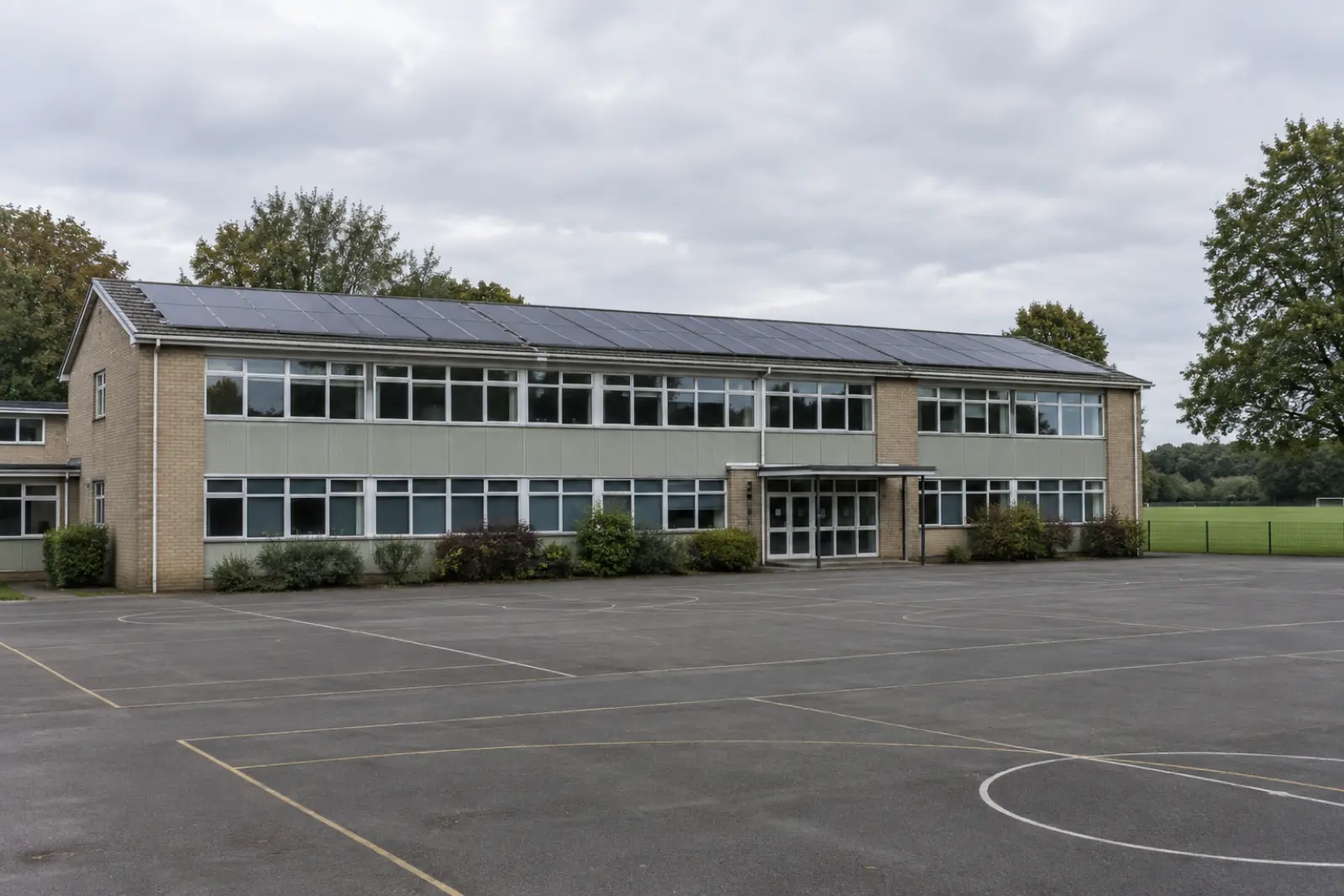
Illustrative layout for an estate of this size. The array is drawn at about 345 kWp, roughly 53 percent of the 650 kWp these three roofs would hold, because a school sizes to the load it can use in term time rather than to the roof it has: generation it cannot use is exported at a much lower rate than it pays to import. The hatched block carries no array because its structure has not been assessed, which on a school of that era is the usual starting point rather than an exception. Your own figures, and which of your blocks can take an array, come from the roof survey.
Solar PV for academy trusts across Cardiff
We model output for Cardiff Bay from the same source we use everywhere, EU PVGIS v5.2, and where a town has no modelled figure in the dataset we take it from the survey rather than publish an estimate.
Cardiff Bay ranks 0 of 4 towns we cover in Cardiff on modelled yield, against a national mean of 886 kWh per kWp. The county runs from 908 to 936, a spread of 28 kWh per kWp. Within Cardiff that difference is small enough to ignore: where the building sits is not what decides this scheme, your consumption pattern is.
The planning position for Cardiff Bay schools
The Renewable Energy Planning Database holds no school scheme for Cardiff Bay and the area around it. Read that as a gap in the record, not a gap in the roofs: the database is reliable above one megawatt and thin below it, and a school array is typically a fifth of a megawatt.
Grid connection through National Grid Electricity Distribution
National Grid Electricity Distribution operates the distribution network across Cardiff, so the export application goes to them. Anything larger than 3.68 kW per phase falls under G99, which means an application before commissioning rather than a notification afterwards. A constrained network is not the end of a scheme. Capping export costs little when the building already absorbs most of what the roof produces.
Send us the school postcode
We survey school and college roofs throughout Cardiff. We need the postcode, a rough roof area and your half hourly meter data if the trust has it. From that we model what the roof carries, what it generates against the timetable, and which of the funding routes actually suits a school of your size.
Lenzie Consulting Ltd arranges the survey and passes your details to an MCS-certified installation partner so they can quote. We do not carry out the installation ourselves.
What Cardiff Bay trusts ask before a survey
- Will the network around Cardiff Bay accept the export?
- National Grid Electricity Distribution is the distribution network operator for Cardiff. Anything above 3.68 kW per phase connects under G99, and the application fixes the export limit. On a school site the incoming supply is often the binding constraint rather than the roof, so we ask that question before anyone sizes an array.