Specialist solar panels for schools in Canton
25.4 percent of what a Canton school roof makes arrives in July and August, which is when the buildings are shut. A survey here starts with the covering and the structure, then the incoming supply, then what the timetable actually draws.
936 kWh per kWp a year at this latitude, so a 320 kWp array, the size applied for at the nearest school scheme on record, models at about 299,500 kWh. Source: EU PVGIS v5.2, SARAH3, 10 degree pitch, 14 percent system loss.
Book a roof survey in Canton- 1 teaching block
- 2 hall and kitchen
- 3 sports hall
- 4 1960s block, no array
- first phase
- later phase
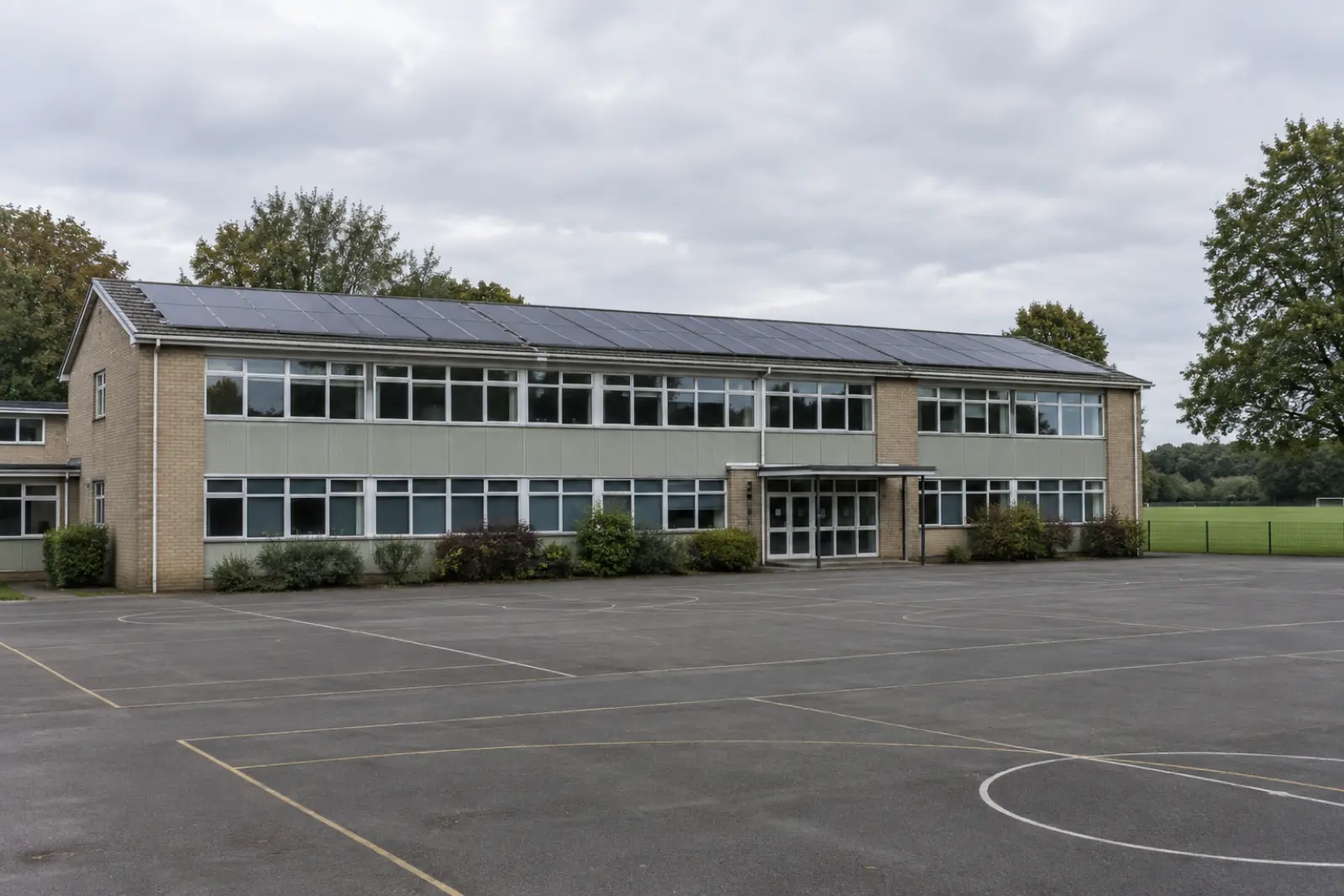
Illustrative layout for an estate of this size. The array is drawn at about 345 kWp, roughly 53 percent of the 650 kWp these three roofs would hold, because a school sizes to the load it can use in term time rather than to the roof it has: generation it cannot use is exported at a much lower rate than it pays to import. The hatched block carries no array because its structure has not been assessed, which on a school of that era is the usual starting point rather than an exception. Your own figures, and which of your blocks can take an array, come from the roof survey.
Solar PV for academy trusts across Cardiff
A one kilowatt-peak array on a shallow pitched roof in Canton models at 936 kWh a year, from modelled irradiation of 1,193 kWh per square metre in the plane of the array (EU PVGIS v5.2, SARAH3, 10 degree pitch, 14 percent system loss). At 6 percent above our mean, Canton is at the strong end of the range, and a roof here earns more for every square metre than the same roof would further north.
Scaled up, a 320 kWp array, sized to what the nearest school scheme on record applied for, 14 miles away at Weston-super-Mare, models at about 299,500 kWh a year before shading, and needs roughly 950 square metres of clear roof. We take the size from the nearest real application rather than a round number, so the example is anchored to something a planning officer has already seen.
Spread across the year that is about 76,100 kWh landing in July and August and roughly 14,400 kWh across December and January. National Grid Electricity Distribution sets what may go back onto the network here, so the July figure is the one worth putting in front of a governing body first.
Canton ranks 1 of 4 towns we cover in Cardiff on modelled yield, against a national mean of 886 kWh per kWp. The county runs from 908 to 936, a spread of 28 kWh per kWp. Within Cardiff that difference is small enough to ignore: where the building sits is not what decides this scheme, your consumption pattern is.
The planning position for Canton schools
Search the Renewable Energy Planning Database for Canton and the area around it and nothing comes back under education. That is worth stating plainly and then setting aside: the register is built around generating stations, a school array is a fraction of the size it captures reliably, and plenty of school roofs never appear in any national record at all.
The closest recorded one is about 14 miles away at Weston-super-Mare: Weston College, a 300 kWp roof mounted array applied for by Weston College, which holds consent and is awaiting construction. We were not involved in it. We cite it because it is a public record of what has cleared planning in this part of Somerset. Source: Renewable Energy Planning Database, Q1 2026.
Why demand in Canton falls as the roof peaks
The generating year and the school year are out of step in Canton. July and August carry 25.4 percent of the modelled output (EU PVGIS v5.2), and the site is closed for most of those nine weeks. June is the strongest single month here at 14.1 percent of the annual total, which is still term time, and that works slightly in your favour against towns whose curve peaks in July.
At the other end of the year the mismatch flips. Only 4.8 percent of output falls in December and January, the two months when a Canton school is fully occupied and its heating and lighting are at their heaviest. The roof makes 6.3 times as much in June as it does in December, and August alone outproduces December by about 5.1 to one. 74 percent of the year arrives between April and September, and the point of that figure is not that the summer half goes unused, because April, May and June are full teaching months that draw hard. It is that the concentration peaks in the few weeks at the end of it when the building is shut.
Across the country the arithmetic settles at roughly 49 percent of output on a session day, against about 71 percent for a weekday business. That figure hardly varies by location, which is why the local numbers that matter here are the yield, the roofs and what has already cleared planning nearby.
Then there is the afternoon. From roughly three o'clock the building empties while the roof is still working, so a system sized on annual consumption will over-generate in exactly the hours nobody is there. We size on half hourly data for that reason.
That argues for a particular shape of scheme rather than against one. Size to the load that does not stop at the end of term, count in lettings, holiday clubs and summer works honestly rather than optimistically, and then decide whether storage or an export arrangement with National Grid Electricity Distribution pays for the surplus that is left.
We set out the complete version of the term time arithmetic on the home page, and what it does to a payback figure under costs.
- generated while the school is open
- generated at a weekend or in the holidays
The same figures as a table
| Month | Session days | Output, kWh per kWp | School open | School closed |
|---|---|---|---|---|
| Jan | 20 | 24 | 15 | 9 |
| Feb | 15 | 41 | 22 | 19 |
| Mar | 21 | 76 | 51 | 25 |
| Apr | 12 | 110 | 44 | 66 |
| May | 17 | 130 | 71 | 59 |
| Jun | 21 | 132 | 92 | 40 |
| Jul | 11 | 130 | 46 | 84 |
| Aug | 0 | 108 | 0 | 108 |
| Sep | 20 | 85 | 57 | 28 |
| Oct | 17 | 50 | 27 | 23 |
| Nov | 21 | 30 | 21 | 9 |
| Dec | 15 | 21 | 10 | 11 |
| Year | 190 | 937 | 456 | 481 |
Grid connection through National Grid Electricity Distribution
National Grid Electricity Distribution operates the distribution network across Cardiff, so the export application goes to them. Anything larger than 3.68 kW per phase falls under G99, which means an application before commissioning rather than a notification afterwards. A constrained network is not the end of a scheme. Capping export costs little when the building already absorbs most of what the roof produces.
Send us the school postcode
Roof condition decides the order of works on most school estates, so that is where we start. Send us the postcode and a rough roof area, with twelve months of half hourly readings if you have them, and we come back with usable area, modelled output against your own load, and the funding routes.
Lenzie Consulting Ltd arranges the survey and passes your details to an MCS-certified installation partner so they can quote. We do not carry out the installation ourselves.
What Canton trusts ask before a survey
- How much would a school roof near Canton generate?
- Modelled at 936 kWh per kWp a year, a 320 kWp array on a Canton school models at about 299,500 kWh. What decides whether that is worth doing is how much of it the school uses itself, not the total. Source: EU PVGIS v5.2, SARAH3, 10 degree pitch, 14 percent system loss.
- How does the school year affect a solar scheme in Canton?
- It goes somewhere, just not into the timetable. 25.4 percent of the Canton generating year lands in July and August (EU PVGIS v5.2), and a closed school still runs servers, comms, refrigeration and ventilation. What that base load does not absorb is either stored, exported under an agreement with National Grid Electricity Distribution, or a sign the array is too big. We test which before sizing anything.
- Which network operator handles the connection at a Canton school?
- Applications go to National Grid Electricity Distribution, who run the network across Cardiff. An export-limited offer usually still works for a school, because the summer surplus is the part you were least likely to be paid much for anyway.